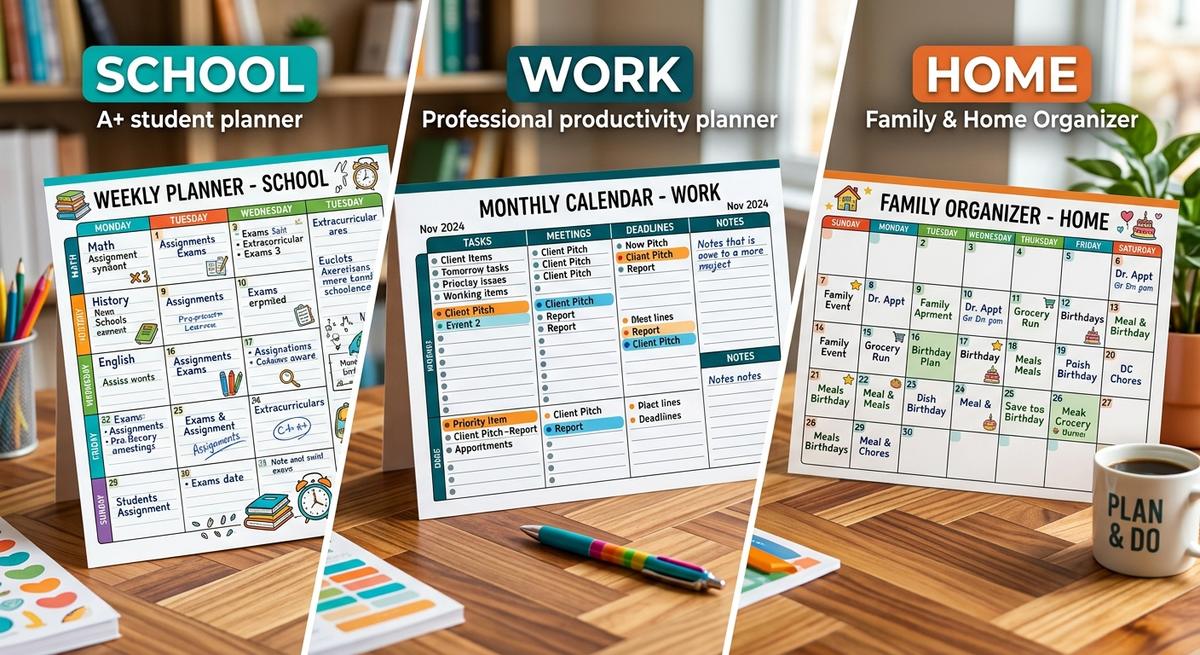
You print a calendar, stick it on the wall, and within a few weeks it stops working for you. Maybe the boxes felt too small for your notes. Maybe you could never tell at a glance which week you were actually in. Maybe the layout just did not match how your days run. This is a common frustration, and it usually comes down to one fixable thing: choosing the wrong format in the first place. There are really only three main printable calendar layouts, and each one was built for a different kind of planner. Once you understand what separates them, the right choice becomes obvious.
At a Glance: Three Things to Know Before You Print
- Monthly calendars give you a wide view of the whole month, making them ideal for tracking deadlines and appointments spread across several weeks.
- Weekly calendars give each day generous writing space, which suits students and office workers who need tight, day-by-day control over their time.
- Week-number calendars use a standardized numbering system to anchor repeating cycles, a favorite for project managers and anyone who plans by quarter.
The Three Core Formats and What Makes Each One Different
Every printable calendar falls into one of three categories. A monthly layout shows all the days of a given month on a single page, arranged in a traditional grid by week rows. A weekly layout dedicates far more space to each individual day, often showing one full week per page or per half-page. A week-number layout uses numbered weeks, typically Week 1 through Week 52 or 53, to organize the year in a way that feels more structural than date-driven.
These three formats are not interchangeable. Each one reflects a different relationship with time. Monthly users think in terms of dates and events. Weekly users think in terms of tasks and time blocks. Week-number users think in terms of cycles and project phases. Knowing which category fits your natural rhythm is the real decision you are making here.
Calendar Format Comparison by Planning Style
| Format | Best For | Writing Space Per Day | Typical User |
|---|---|---|---|
| Monthly | Overview, appointments, deadlines | Small | Home planners, teachers, parents |
| Weekly | Task lists, time blocks, daily routines | Generous | Students, office workers, freelancers |
| Week-Number | Project cycles, fiscal quarters, reporting | Varies by template | Project managers, finance teams, planners |
Monthly Calendars and the People Who Love Them
The monthly layout is the most familiar format around. It shows a full month in a grid, with each day represented by a small square or rectangle. For many people, this is exactly what they need. You can see your whole month in one glance, which makes it easy to spot scheduling conflicts, count days until a deadline, or track a recurring appointment without flipping through pages.
Home planners tend to gravitate toward monthly calendars because family life runs on broad strokes. You need to know when school breaks fall, when the dentist appointment lands, and which weekends are already booked. A monthly grid answers all of those questions at once. It lives on the wall and does its job without requiring anyone to interpret it.
Teachers also rely on monthly formats heavily. A classroom calendar lets students see the rhythm of the school term, including test dates, project due dates, and holidays, all without turning a page. When the calendar lives at the front of the room, a monthly grid is the only format that reads clearly from a distance. A weekly layout simply has too much fine detail to absorb from across a classroom.
The one real limitation of a monthly layout is writing space. Each day's cell is small. If you write detailed to-do lists or need to note several tasks per day, you will constantly run out of room. That is the moment to consider a weekly format instead.
How Weekly Calendars Fit the Rhythms of School and Office Life
A weekly calendar gives each day its own generously sized box or column. That extra space changes everything for people with busy, task-heavy schedules. Students can list assignments under each day without squeezing. Office workers can block out meeting times, note follow-ups, and track project milestones in a format that actually has room for that level of detail.
The weekly format also encourages better time awareness. When you can see Monday through Sunday laid out in front of you with plenty of room to write, you naturally start thinking about how you will actually spend each hour. Monthly grids are better at keeping the big picture in view. Weekly grids are better at managing the ground-level reality of a packed day.
Time-Blocking and the Weekly Grid
Time-blocking is a planning method where you assign specific hours to specific tasks. It is popular among students studying for exams, professionals juggling multiple projects, and anyone who tends to lose track of where their hours go. A weekly calendar printed in a vertical format, with each day divided into hourly rows, is the natural home for this kind of planning. You write "study chemistry" from 3 to 5 PM on Tuesday and "team meeting" from 9 to 10 AM on Wednesday. When you sit down each morning, the structure is already there waiting for you.
Vertical weekly layouts also make it easier to spot overcommitment before it happens. If Tuesday's column is completely filled and Friday's is nearly empty, you can redistribute tasks before the week begins. That kind of visual feedback does not exist on a monthly grid, where every day looks roughly the same regardless of how full your schedule actually is.
Week-Number Calendars and What the Numbers Actually Mean
Week numbers feel unfamiliar to many casual planners in the United States, but they are standard in project management, supply chain scheduling, and corporate planning worldwide. The week-numbering system divides the year into 52 or 53 numbered weeks. International week numbering follows ISO 8601 conventions, which specify that Week 1 is the week containing the year's first Thursday. This shared standard makes it possible for teams across different countries and industries to reference the same period without any ambiguity.
For planners who manage multi-week projects, week numbers provide a cleaner reference point than calendar dates. Instead of saying "the report is due the third week of March," a project manager can say "due in Week 12." Everyone on the team looks at the same week-numbered calendar and finds the same reference point instantly. There is no room for confusion about which week you mean.
At home, week numbers can also be surprisingly practical if you plan on a quarterly or seasonal basis. Gardeners track planting weeks. Fitness enthusiasts track training cycles. Anyone who repeats a routine every eight or twelve weeks can use week numbers to count those cycles without doing any mental math. Once you start thinking in weeks rather than dates, many recurring plans become much easier to manage.
How to Match Your Lifestyle to the Right Calendar Format
Matching the format to your habits is far more reliable than picking whatever looks attractive in a preview thumbnail. Here is a practical process you can follow to zero in on the right layout:
- Count how many things you write per day. If you jot down one or two items, a monthly layout gives you enough room. If you regularly write five or more items per day, a weekly layout will serve you far better.
- Ask yourself how far ahead you usually plan. If you are always thinking in terms of the next four to six weeks, a monthly view fits your mindset. If you rarely think beyond the next seven days, a weekly layout keeps you working in your natural zone.
- Consider whether you work in project cycles. If your work involves sprints, quarters, or fiscal reporting periods, a week-number format will connect your paper planning to the language your workplace already uses every day.
- Think about where the calendar will live. A wall calendar that needs to be readable from across the room demands a monthly layout. A desk calendar you reference while sitting can work as either monthly or weekly. A personal planner you carry with you is almost always better as a weekly format.
- Consider who else will use it. A shared family calendar works best as a monthly layout because everyone can contribute at a glance. A personal productivity calendar works best as a weekly format because the detail level belongs to one person.
Running through these five points usually narrows the choice fast. Most people land clearly on one format after answering even the first two questions. If you still feel pulled between two options, print one page of each and carry both through a single week. The one you actually write on is your answer.
Previewing Different Layouts Before You Print a Full Set
One of the smartest moves you can make before printing a stack of calendars is previewing several layout options side by side. Different templates vary more than people expect. Some monthly grids start weeks on Sunday; others start on Monday. Some weekly layouts run vertically with one day per column; others run horizontally with time slots stacked down the page. These design choices matter far more than most people realize until they have already printed something that does not quite fit.
Free resources that offer multiple template styles allow you to do exactly that kind of comparison before committing to a download. Browsing a collection of printable calendar options organized by date index gives you a genuine sense of how each format reads before you commit to a print run. This kind of side-by-side preview catches issues that a thumbnail alone cannot reveal, like whether a weekly layout gives enough room for your handwriting or whether a monthly grid uses the paper space efficiently.
Once you have settled on a format, grab the file type that fits your workflow. PDF files print cleanly on standard US Letter paper without any formatting adjustments. Word templates let you type in dates, add recurring events, and resize columns before printing. Excel templates let you pre-fill cells with formulas and color-code categories. Each file type has a real use, and choosing the right one saves you from reformatting a template from scratch every month.
The Format You Pick Is the Plan You Will Keep
A calendar format is only useful if you actually use it. That sounds obvious, but it is easy to forget when you are drawn to a template that looks clean or feels official. The format that sticks is the one that matches how your brain already organizes time, not the one that looks best on the wall.
Students who picked a monthly format and then abandoned it because the boxes were too small are not bad planners. They just picked the wrong layout. Office workers who tried a week-number system but never internalized the numbers are not disorganized. The format was simply designed for a different use case. Matching the layout to the actual pattern of your days makes planning feel natural instead of forced.
Start with what you already know about yourself. Do you think in days, in weeks, or in project phases? Your answer points directly to a format. From there, grab a free PDF to print as-is, a Word file you can customize with your own dates and recurring events, or an Excel template you can pre-fill before printing. Try one page for two weeks and adjust from there. Getting the format right early changes how consistent your planning actually becomes, because you stop fighting the layout and start using it.